We’ve all grimaced at the taste of chlorine, but we wondered whether our filter pitcher was really a reliable ally or just a breeding ground for bacteria. So we did a little digging to see if this jug actually purifies water or strips it of essential nutrients while contaminating our glass. Get ready to rethink your habits, because we’re going to shine a light on the hidden risks of filtration and the maintenance mistakes that often turn fresh water into culture broth 🦠.
- Filter pitchers: a breeding ground for bacteria if you’re not careful
- What filters really remove (the good and the bad)
- Using your pitcher safely: the how-to guide
- What if the solution lies elsewhere? Alternatives to pitchers
Filter pitchers: a breeding ground for bacteria if you’re not careful
The real risk: bacterial proliferation
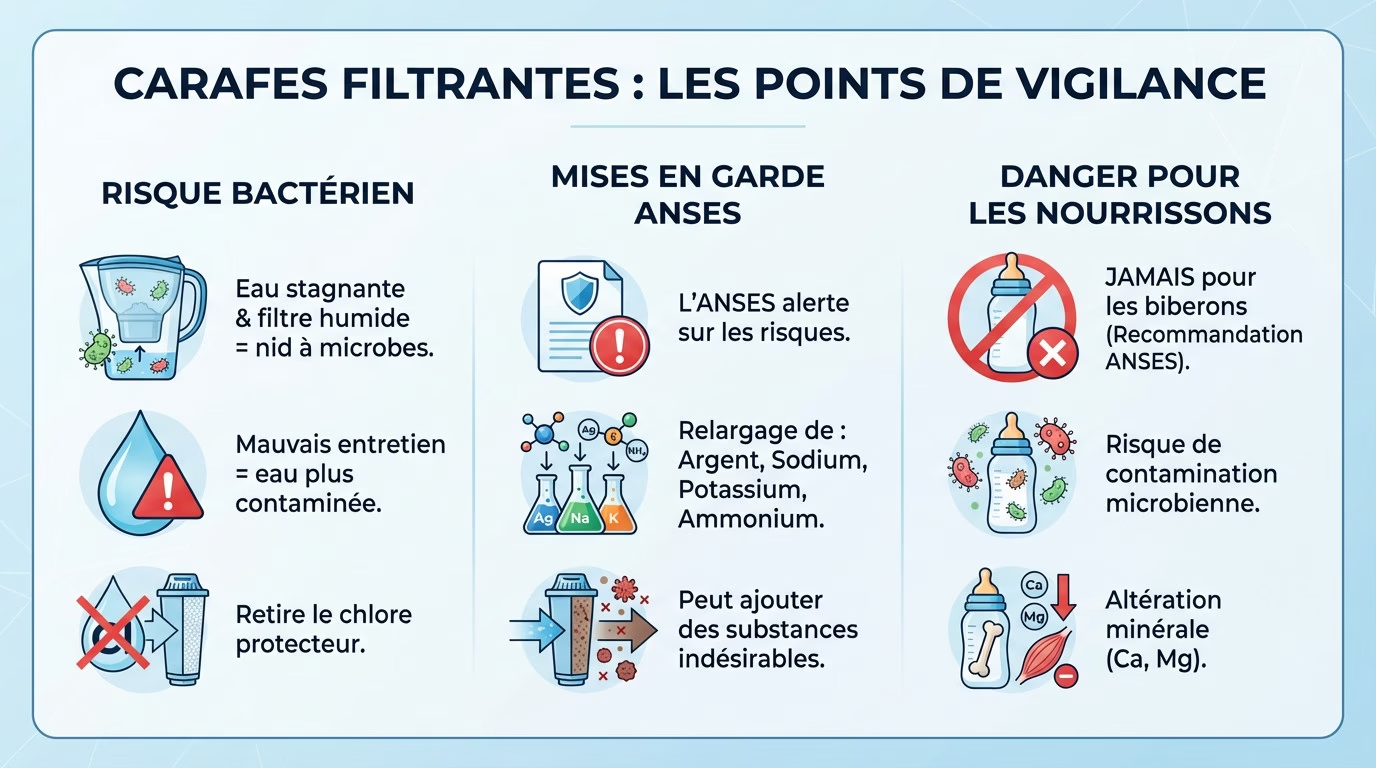
We quickly understood the underlying problem: with its stagnant water and damp filter, the pitcher offers a dream environment for microbes. The filter traps organic matter that literally feeds bacteria.
It seemed crazy to us, but if maintenance isn’t rigorous, you end up drinking water that’s potentially more contaminated than tap water. Instead of protecting you, your filter pitcher becomes an active source of contamination.
Tap water contains chlorine to prevent this, but the pitcher removes it. Without that barrier, germs have a field day.
What ANSES says: watch out for substance release
We looked into ANSES’s opinion and their conclusions are thought-provoking. The agency analyzed these home devices and issued warnings we hadn’t suspected at first.
The irony is that filters can release substances into your glass: silver ions, sodium, potassium, and even ammonium. We think we’re purifying water, but we risk adding unwanted chemical elements in the process.
These results prove that effectiveness isn’t automatic. We then wonder why filter tap water if the device itself can cause more problems than it solves.
The warning for infants: never do this
If there’s one rule we follow strictly, it’s ANSES’s recommendation: never use water from a filter pitcher for baby bottles. It’s an unnecessary risk for little ones.
Two reasons explain this categorical refusal: the danger of microbial contamination if the pitcher is poorly washed, and especially the mineral modification. Filtering can deprive the baby of calcium and magnesium essential for growth.
What filters really remove (the good and the bad)
Goodbye chlorine taste, but not only that
Let’s be honest, if we looked into the filter pitcher health issue, it was first for the taste. No more feeling like you’re drinking pool water! This little miracle is performed by activated carbon (often coconut-based) which traps chlorine with remarkable efficiency.
But digging a bit deeper, we discovered that this carbon doesn’t stop there. It can also retain certain organic molecules, like pesticide residues. That’s a positive point, we’ll grant you, even if the actual effectiveness varies enormously from one model to another.
The loss of essential minerals: a real problem?
Then there are those famous resin beads found in cartridges. We love them because they fight limescale. For protecting our kettles and coffee machines from scaling, it’s genuinely effective.
On the other hand, there’s a downside we hadn’t seen coming at first. These resins remove limescale, but they also take away essential minerals like calcium and magnesium. The water becomes softer, for sure, but it becomes significantly depleted in the process.
That seemed problematic to us, especially for teenagers or elderly people, for whom these daily intakes via water are really not negligible.
More acidic water—what does that change?
We’ll detail another side effect often overlooked in this long journey toward pure water. Filtration has an unfortunate tendency to lower the pH of water, making it more acidic. It’s the direct consequence of removing the minerals we just mentioned.
This acidity, even if it remains mild, can over time promote corrosion of certain metals. In short, it’s not ideal for durability of appliances like coffee makers, contrary to what we believed.
Using your pitcher safely: the how-to guide
The golden rules of maintenance (never forget them)
Let’s be honest: your pitcher’s safety relies entirely on your diligence. Without serious maintenance, you’ll get no benefit.
We’ve summarized the essential steps for you in this table, because a simple oversight quickly turns the accessory into a formidable bacteriological trap 🦠.
| The action | The right practice | The risk if neglected |
|---|---|---|
| Change the cartridge | Every 3 to 5 weeks (follow the instructions!) | The filter becomes a breeding ground for bacteria and releases what it filtered. |
| Clean the pitcher | At least once a week (hot water and soap) | Proliferation of microbes and mold on the walls. |
| Consume the water | Within 24 hours maximum | Water stagnates and bacteria develop. |
Where and how to store filtered water
Never leave the pitcher sitting on the counter at room temperature. That’s a fatal mistake. Heat accelerates microbial proliferation. Water quickly becomes an invisible culture broth if you’re not careful.
The rule is simple: as soon as water is filtered, the pitcher must go in the refrigerator. Cold significantly slows bacterial development and preserves water quality. For a reliable filter pitcher, here’s the recap:
- Change the cartridge on time (every 4 weeks max).
- Clean the pitcher every week.
- Keep water cold and drink it quickly.
What if the solution lies elsewhere? Alternatives to pitchers
We’ve seen the advantages but also the risks if maintenance is lacking. So, for those still unsure about the filter pitcher health equation, know that other options exist to improve your tap water without these hassles.
Faucet-mounted systems: a first step
To start, we tested filters that screw directly onto the faucet. It’s night and day in terms of flow compared to pitchers. No more water sitting on the counter for hours—we found that much healthier.
Sure, you still have to change cartridges, let’s be honest. But models like the ÖKO Tap Water filtration system are game-changers with more advanced technology. The taste is genuinely better and the filtration seemed more serious to us.
Portable filtration: filter bottles
Next, we fell for filter bottles 🎒. The concept is brilliant: water is treated the second you sip. So no risk of bacterial stagnation—it’s instant.
It’s the ideal option if you’re always on the move and want clean water everywhere, without depending on a pitcher at home. We actually looked into the match between filter bottles and pitchers. Spoiler: the bottle often wins on practicality and sanitary safety.
Cartridge-free technologies: the future of filtration?
Finally, we discovered something that blew us away: solutions that do away with cartridges entirely. We’re talking about purification by UV-A rays. It’s an approach that’s completely off the beaten path.
Here, we don’t filter, we purify water by eliminating chlorine, pesticides, and especially microbes. The big plus is that it doesn’t touch the good minerals. It’s zero waste, super eco-friendly, and it solves taste issues without the usual hygiene risks.
For us, the filter pitcher remains a nice option for taste, but it requires serious discipline ! If rigorous maintenance isn’t your thing, alternatives like bottles or UV systems are really worth a look. Choose your side for healthy water! 💧✨
This post is also available in:
 Français (French)
Leave a Reply